Ethical Addictions Logo link to homepage

Money down the toilet! 🚽

Whenever we are in East Africa, we’re not only checking coffee quality and sorting the next year’s crop, we are looking for opportunities to invest in communities and improve lives. We believe in the power of business to do good, and the ‘full circle’ whereby we not only trade directly, honestly and generously, but with our profits, we look to give back even more to the people who grow our coffee.

Ian with John, head teacher Pascalina and friend

At the end of 2022, we visited Omi School in Mweka, Northern Tanzania. This is the local school where the children from the coffee-growing families, that we know and work with will go. Whilst visiting we saw the terrible state of the current toilets.

The government had built the basic structure of two new toilet blocks – one for the boys and one for the girls. However, that’s as far as it went. Unfortunately there was no more funding to finish the build, they still need access steps, doors, windows, plumbing, painting and finishing. There is still a lot to do! This felt like a great project to get involved with – relationally as we know the families, and because it will have such a positive impact on health and hygiene.

So discussions started with John, a local education support officer and Pascalina, the Omi school headteacher to see if and how we can help. Excitingly, in February we sent the money to complete the toilet blocks.  John has met with the school committee and the MP, so we’re ready to go!

Scroll down to the bottom of this page to see the short thankyou from the school children. 

Update

Update images below.

Completed!

❛❛

Hello, we are incredibly happy to have a modern model toilet in the whole district. We are very happy, teachers, students, and all the school committee, especially girls. we thank them. Thank you very much to you and your family together with Mr. John for good management, and for our efforts, we pray for you.

God bless you very much, our children are happy, also on behalf of the elementary school committee, we are happy.

Head Teacher Pascalina

❜❜

Cameroon Boyo ~ Impact of the Coronavirus

Back in June our friend in Cameroon, Matti Foncha, who we buy our Cameroon Boyo coffee from, uploaded a video to YouTube where he talks about how the coronavirus  has affected him and coffee production. We have also included a transcript for people who would prefer to read rather than watch the video.

Impact of the Coronavirus Crisis

on the production & direct trade of coffee from Bamenda

Transcript (11 June 2020)

My name is Mattie Foncha. I’m a farmer and I’m in Bamenda (Cameroon). We grow coffee as well as many other crops which we take to world markets. I organise and coordinate the work of so many other farmers in this region but when the government banned travel and closed the borders because of Covid 19, I found myself at home with my elderly mother. She’s in her nineties. So it places both her and me in the high risk category for Covid 19.

In Bamenda most people have not really felt the true impact of Covid 19. We haven’t seen the dramatic deaths that they’ve seen in other countries around the world. People go through the motion. We wear masks and we try to keep our distance but people don’t really truly understand what it’s about so I am glad that I happen to be home with my mother when this travel ban was imposed and I’m going to continue to be here until I am absolutely sure that she can be protected and kept safe. So yes in a way Covid 19 has affected me and my life but it’s in a way for me it’s a positive effect because it gives me a chance now to be sure that I’m giving my mother the best protection she can get at a time like this.

Our main production is coffee. I’m in the farm here where you can see a lot of coffee trees but we also grow beans and other crops along with the coffee. So when we were faced with the issue of Covid, my own work professionally got a little bit disrupted because typically I’ll go to market areas mostly in Europe and the United States. We also have customers in Asia.

I will visit our customers and make arrangements for pricing. We sell our coffee directly to the world market and directly to farmers. That was directly to coffee roasters. So not being able to travel we had to restructure how we work and so now we mostly use online channels to communicate. We use social media as much as possible but we also use direct emails, phone calls and that way we can keep ourselves going.

Why we were able to do this and not feel too much the effect of Covid is because we built up very strong relationships. Direct sale relationships, direct trade relationships. For the roasters who handle our coffee and then the roasters for us who they trust to do the right thing to give them quality.

It is mid- August … the daily rains have stopped, but only for about a week – our “small dry season” – time to harvest and replant supporting crops. Let’s hope that that the rains resume soon – good for our farms, good for our coffee!

Our hometown Bamenda is still functioning pretty good because again the dramatic effect of Covid hasn’t really hit home yet so we go through the motions when you go to the bank they keep a social distance . When you go to churches they are also like that but the markets are still open and people enter crowded buses and crowded motorcycles so we have some ways to go but again were fortunate that the rest of the world has experienced Covid and they’re able to give us some pointers for what to do to take care of ourselves.

Were obviously looking forward to what people call the new normal that’s going to be coming up post Covid but I somehow think were already living the new normal when you look at sister city relationships like Bamenda and Dordrecht and you look at the potential for direct connection in that way that is how trade should have been and that is how were developing our trade. Intimately connecting the partners one with the other and in the spirit of mutual respect and trust that each party will do whatever it can do to empower the other one and were very very grateful for the people of Dordrecht for being our partner and our sister city.

Recommended Reading

You can also find out more about what the country of Cameroon is going through right now then we recommend the following:

BBC article on the city of Bamenda (Cameroon)

Video by the Washington Post:

Cameroon, divided by two languages, is on the brink of civil war:

Introducing the r-cup

We were so impressed with this product that we decided to stock it! If you are after a great product to drink your ethical filter coffee on the go, from then this is it.

Here are five reasons why we love it:

  1. 100% leak proof* and easy to open/shut
  2. 360 degree drinking like a normal cup
  3. Fully Insulated
  4. Made from used cups
  5. Our coffee tastes great from these cups

Materials

All components in contact with beverage – Polypropylene BPA free and food grade certified Outer cup vessel Recycled Polypropylene and post consumer paper coffee cups (+ 5% levels of HIPS lids and straws). Inner spring Stainless Steel 304 Seals x2 silicon
 
* We tested it, it really is leak proof!

BBC video of EA water projects

BBC radio interview today about the latest trip to Tanzania and Ian becoming a tribal chief.

To promote this interview, they took pictures and videos that Ian had recorded on location in Tanzania and turned it into this short video that was shared online.

Video Transcript

  • This is the first time Cecilia has used clean running water
  • She lives in Tanzania where Ian Meredith from Gloucester, gets his coffee.
  • He owns Ethical Addictions – an ethical coffee company.
  • He’s also been supporting long-term development for Mweka villages…
  • Like getting running water to people like Felicita, who live on Mount Kilimanjaro.
  • In 10 years, Ian says he’s witnessed huge changes in living standards.
  • The village of Orera is so grateful to Ian…
  • They’ve made him a chief of the Chagga Tribe!

This kind of thing cheers us up….

We received a video last week from the Orera Village expressing thanks (in words and song!!)


Transcript

“Thank You so much. I am so grateful that I received more money than I previously did. Thank you so much Ian … and please continue in the same spirit 😊” 

“Firstly, I would like to thank Ian for elevating us farmers from the village of Orera. Secondly I would like to thank my fellow farmers. We’ve produced a great coffee crop together. We are fully committed to producing a great, great, great coffee again.

There’s something else I wanted to say. Getting more money for our coffee enables us to educate our children better. Let’s continue making great coffee that is loved by our buyers.”

“Christina thanks our chief of Chagga. She says they have been full and now they have been seriously elevated.”

Coffee process: Tanzania. Ethical Addictions Farm Direct

African Coffee

It took me a while from hours of video and hundreds of photos but here is a short video to help better understand the processing of coffee on the farm in Tanzania. (The background music is sung by the Orera villagers where we also buy coffee!)

Transcript from Video

  • Careful selection of each hand picked cherry helps define the crop quality.
  • Bringing in the harvest. Pickers carry their cherries back to the farm to be processed.
  • Back at the farm. Each picker lines up to get their cherries measured and processed.
  • Bucket by bucket each day’s harvest is measured and recorded before the washing process begins. From the collection basin the cherries now pass to the pulper to remove the pulp from the fruit and get the beans (seeds) from within.
  • The pulper separates the pulp and directs it into a storage tank where it is later dried to make cascara (a tea-like drink).  The coffee beans are directed into the washing channels for cleaning and to further sort quality.
  • The coffee beans now rest in their own watery sugar solution to ferment until a second washing to further separate any remaining pulp.
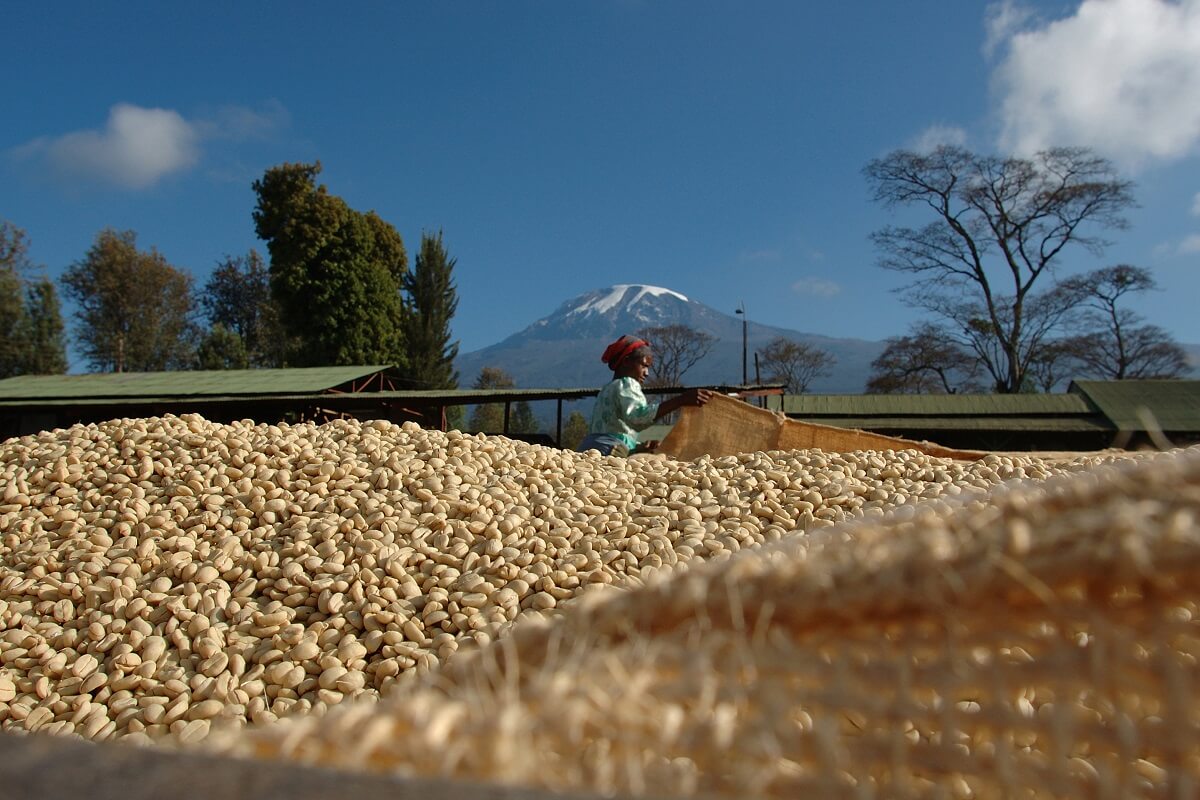
  • then it’s carried to the sorting racks to be hand-sorted for stones and defects and laid out to dry naturally in the African sun.
  • Finally the beans are bagged and weighed before being sent to the mill to have their husk removed and be graded, and bagged for export.

Some additional footage of the farmers on the Machare farm recorded five years earlier.

Ethical Addictions Coffee Roasters
Privacy Overview

This website uses cookies so that we can provide you with the best user experience possible. Cookie information is stored in your browser and performs functions such as recognising you when you return to our website and helping our team to understand which sections of the website you find most interesting and useful.