Ethical Addictions Logo link to homepage

Colombia – Ian & Elliott’s Excellent Adventure

Bogata at 6am is a bustling metropolis. Street vendors sell food to the swathes of commuters whilst bike repair stands line a buzzing cycle lane full of professionals making their way to work. Crossing the road at times feels like taking your life in your hands but in truth it adds to the adventure. As a city, Bogota is a strange mix of modern high rises and colourful murals that tower above traditional houses and churches nestled at street level; and to its east the city ends abruptly meeting a wall of green mountains. The cable car up to Monserrate gives you a vantage over the sprawling city, a city full of trendy coffee shops and university campuses alive with students heading to lectures giving an air of a country ready to innovate and push forward into a better future.

GACHETA

The DNA of Ethical Addictions has always been to support small coffee producers who have great coffee but limited access to market – it’s why we trade directly; it’s why we fly halfway around the globe to sit in a restaurant with its own trout farm several hours outside of Bogota. We are meeting with Victor and Lucio, two of the smallholder farmers in the village of Gacheta.

Ian was here last year visiting for the first time but even on our return a year later it is like meeting with old friends. It’s not long before the conversation turns to coffee and some of the challenges that they are facing. There are issues around labour with many of the young people leaving for the cities, Lucio’s son tells us he is hoping to pursue a career in computer science which is just a snapshot of the issue. There are also issues around climate change, all of the coffee farmers across Colombia are praying for rains that should have already arrived. Without the rain the coffee cherries won’t ripen. There are also some issues with the current crop of trees for these smallholder communities. The first is rust – a disease that damages the leaves and fruit of the coffee trees. The good news is that there are some coffee varietals resistant to rust. The second major problem is the age of some of the trees on the farm. 

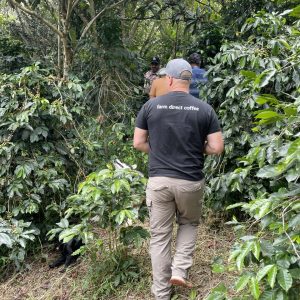
Walking around Lucio’s smallholding both of these problems are clear for us to see. There are telltale signs of rust on some of the trees, while others are struggling with the drought and others are showing their age with low yields of cherries on the branches. We see an occasional red cherry though most of them are green, longing for rainfall. 

While we can do little about the lack of rain, it is clear that one of the ways EA can invest in farmers like Lucio and Victor in Gacheta is to invest in new trees and encourage collaboration amongst the community. By buying some new seedlings in rust resistant varietals this will help rejuvenate the small holdings and in the long run lead to better quality and better yields of coffee. It also gives them a safe way for them to experiment with some more exotic varietals.
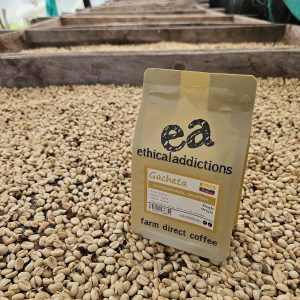
gacheta bag on location 06-min
gacheta walking lucio farm 02-min
MEDELLÍN

We have a few days before we are scheduled to travel to La Primavera to visit Francisco on his farm, so we get to take a short trip to Colombia’s second city, Medellín. 

Colombia is still a new origin for us and as we spend more time on the farms we are also keen to explore the country to help improve relationships and understand Colombian culture and history more (also we both really wanted to go).

Medellín is a city with a history (not all of it good), but now is revived to be a creative city, full of potential and opportunity. Its public transport system, links the affluent suburbs with instagram-friendly malls and onto the winding narrow alleyways of the near-vertical neighbourhoods of the comunas.

Nowhere tells this story better than San Javier (Comuna 13). This Community is testament to the resilience and innovation of its residents. Once considered the most dangerous place on earth, these streets are now bustling with tourists. There are brightly coloured murals on almost every surface and surreal sculptures emerge from parapets of houses and bars. Small shops and restaurants run up and down the maze of streets, there is even a small coffee roastery tucked away. The main street is serviced by outdoor escalators that encourage tourists up to the higher levels. Youth groups perform breakdancing routines for groups of tourists as a means of making money away from the gangs. Taking the cable car over the rest of the community away from the tourists gives you a sense of the scale of challenge still facing the city, it is clear there is still more that needs to be done. But it is a city that is no longer fearful but rather hopeful. 

LA PRIMAVERA

This La Primavera Finca (farm) is constantly looking for ways to improve their practice and respond to the various challenges of modern farming, international economics and climate change. 

At the centre of this is Francisco. To call Francisco just a farmer is to understate what he does. In truth he is a botanist, biologist, ecologist, engineer, economist and entrepreneur! As we walk around the farm Francisco explains how he is using each of the lots. Some he has stumped (cutting the older trees back to the stumps to allow new growth), in others he has started to plant newer varietals such as Tabi, and inothers he is running agronomy experiments.  

The soil at La Primavera is a challenge and drought is only making it more difficult. The farm was once used for cattle grazing which has caused problems with retaining nutrients. The dry ground is now cranking, making this retention even harder. Francisco is monitoring the soil for its nitrogen content as well as other various minerals that he is hoping various composting methods will help return some of the lost nutrients to the soil. He uses compost created at the farm (which he also uses for biogas); a series of fences made from sustainably harvested bamboo; as well as biochar which he hopes will help prevent the nutrients running off during heavy rains.

He has diversified as well. There is a bamboo guesthouse taking shape that will allow them to run experiences and retreats. And his brother us raising pigs. 

Having brought the milling to the farm he is also able to ensure the quality through that process too. As well as being able to offer milling to other farmers, including the coffee that we will get from Gacheta.

This innovation isn’t at the expense of the environment though. La Primavera is a sanctuary for all kinds of wildlife – in fact it is certified bird friendly! The coffee is shade grown amongst indigenous trees. Huge Areas of the rainforest are preserved and a host of hummingbirds drink nectar from the array of flowers that grow everywhere.

It is a very, very special place, and a priveledge to have got to spend time there.

FINAL THOUGHTS

Colombia is a nation of innovators, and Francisco is a great example of this. He is constantly striving to do better for coffee, people and the environment. He is bringing others with him. His connection and expertise make the relationship between EA and the Gacheta community work. Lending his knowledge to help improve practices not only on his own farm but also amongst other farmers too.

It is also alarming to see the impact climate change is having on these communities. Seeing first hand the impact of changing rainfall patterns and periods of drought that farmers are increasingly experiencing and the effect that has on coffee production as a result of their source of income is a stark reminder of what is at stake. 

But all of this reminds us of why we chose to trade directly and the way that relationship, even only a couple of years in, can have big impact, like being able to invest back into the farmers in Gacheta. 

We are leaving Colombia with a renewed excitement about the coffee itself, and the impact we can have. We will continue to build and invest in this partnership. And not just because it gives us a chance to visit and drink more coconut lemonade (though that is definitely a perk).

Origin Report: Kilimanjaro

Table of Contents

Introduction

It’s late November 2022, Ian and I have travelled to Tanzania and the slopes of Kilimanjaro to visit the farmers, smallholders and friends that grow our coffee. For EA the relationships in Tanzania are the oldest we have and are a key part of our story. Regular trips and visits to the farm and the villages have been a critical part of not only securing contracts, but maintaining friendships and identifying where we can help with projects.

In the past few years, the global pandemic has put a rain check on any plans for travel and as such there is much that we need to catch up on. Personally, this is my first trip to origin, so there is a great deal for me to learn.

Machare Farm

A few days into our visit and much of that time has been spent learning about coffee, not in a classroom or from a book, much of what I have learned were things that I thought I had understood from what I had read or been told. It wasn’t until I saw them in practice that I gained a true understanding of the magnitude, means or care given in each stage of the process.

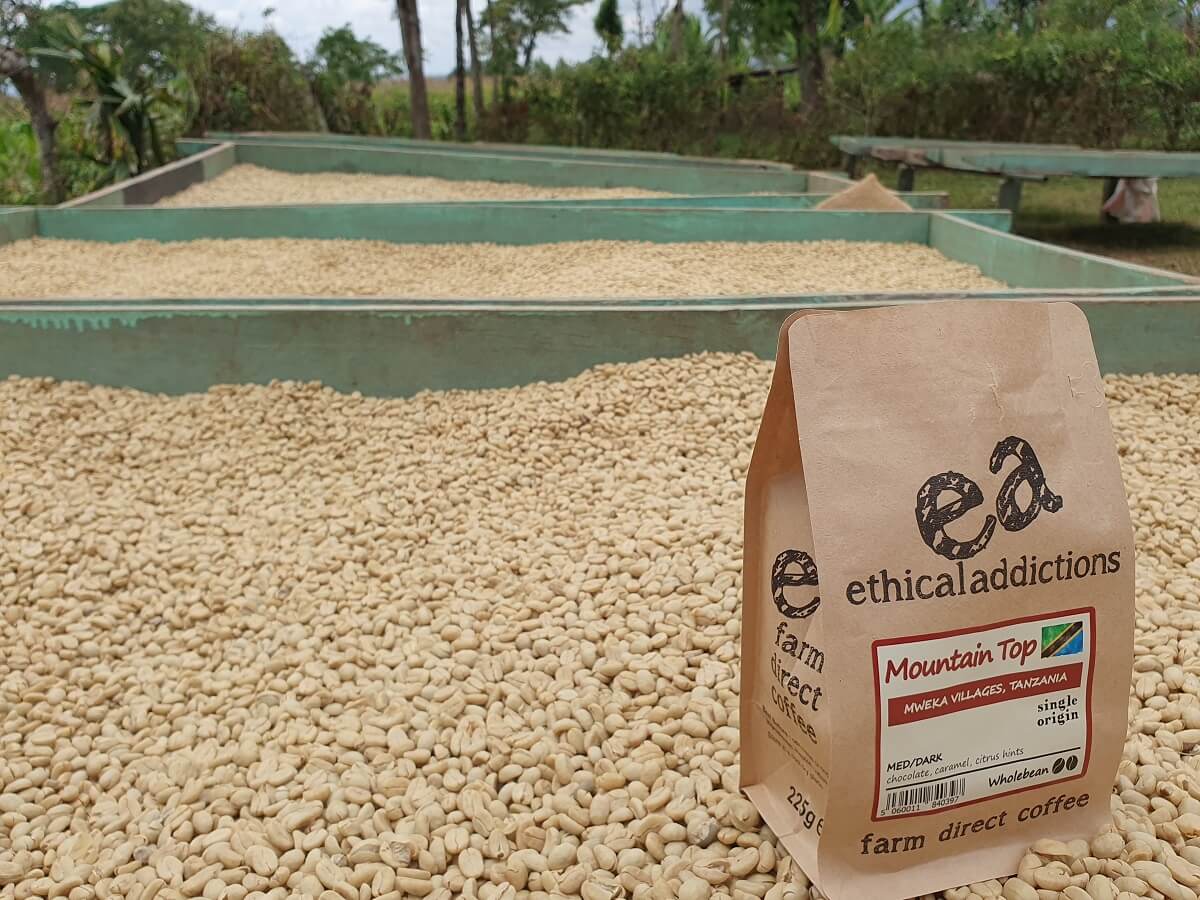
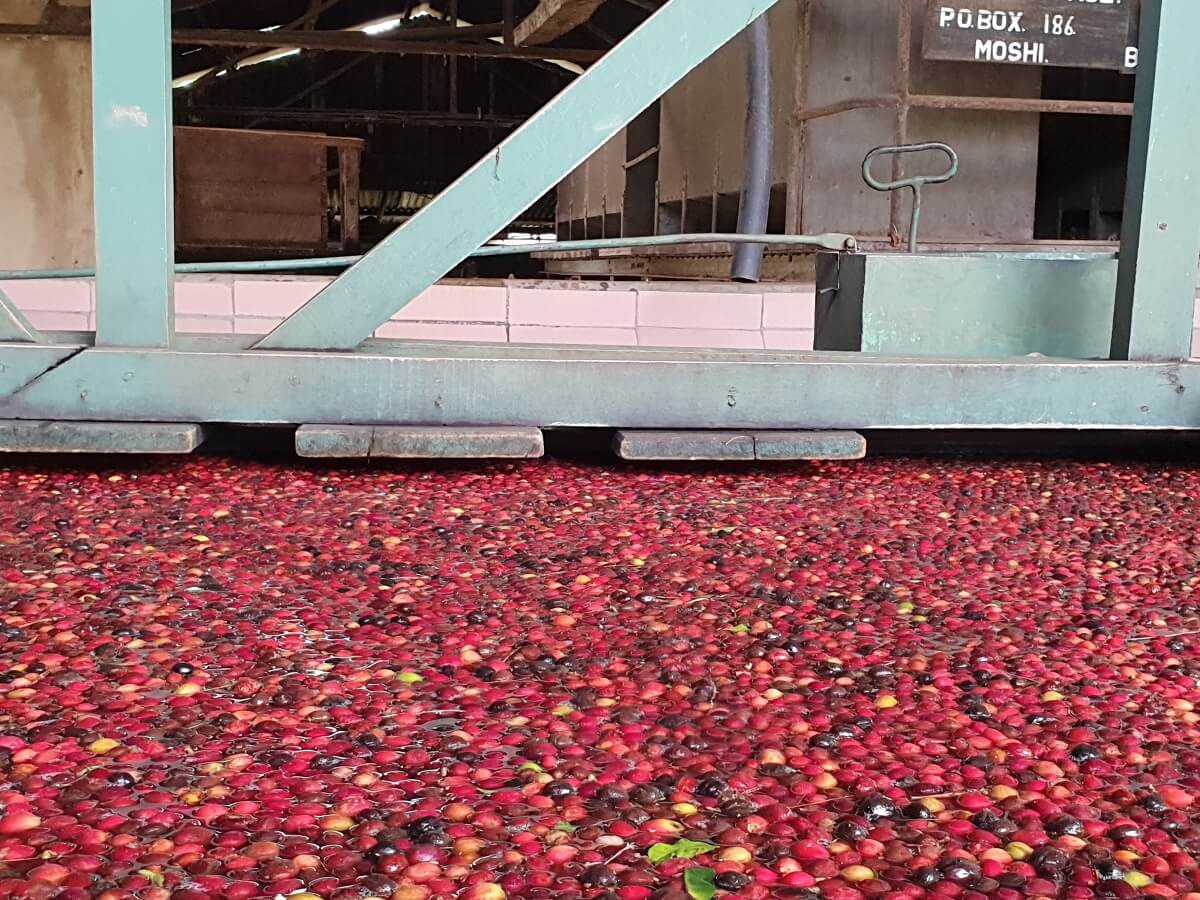
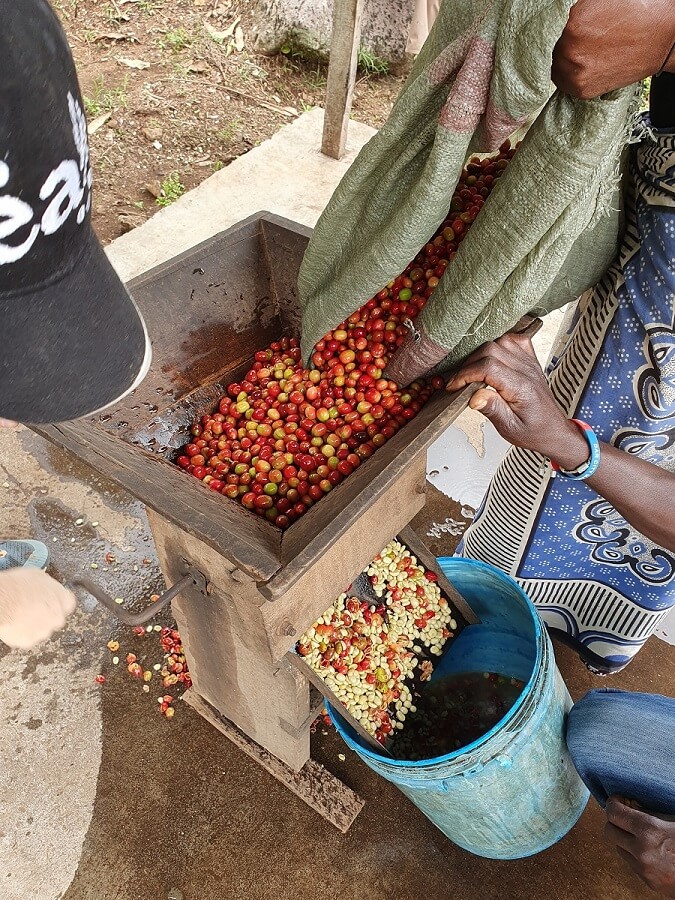
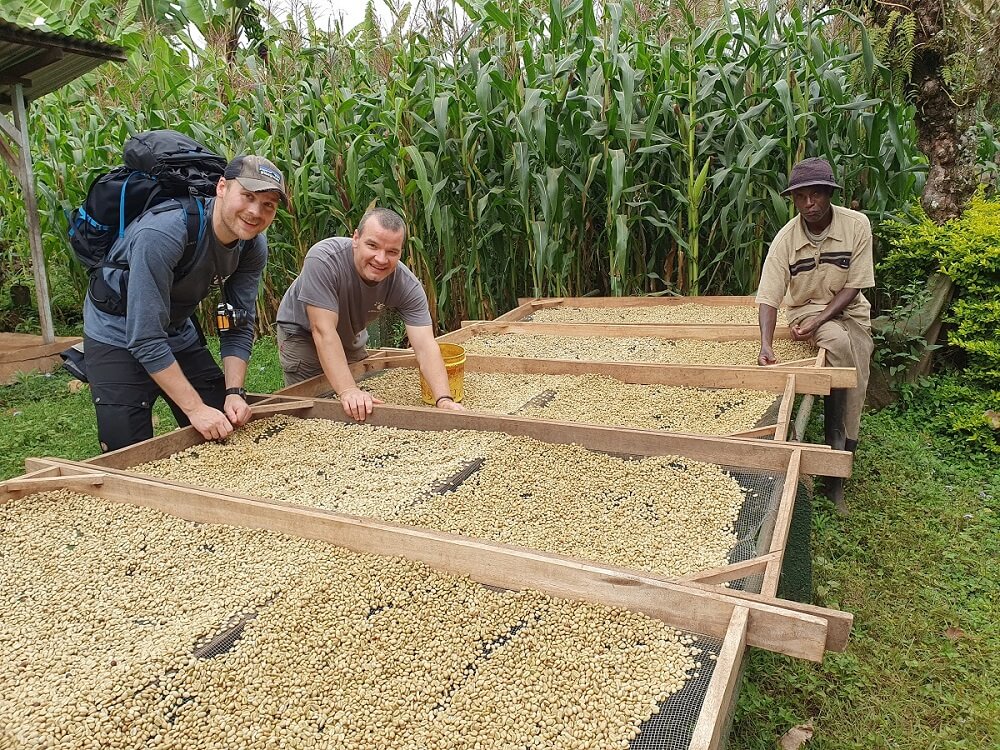
At the farm I have seen the cherry be sorted in the syphon, pulped, washed, fermented and sorted during a second wash; I have watched and helped with the tireless process of hand sorting the beans on the drying tables. Although the magnitude and the means are impressive, it is the care that is given at every stage of the process that is truly astounding. That process begins in the nursery with the care given to the coffee trees themselves right up to the beans being milled and packed ready to be sent to Ethical Addictions for roasting.

This care also extends beyond the farm and the small holdings to the environment that they rely on. Reusing the pulped cherry as compost,growing coffee amongst the indigenous trees (shade grown), and building beehives.

Picking coffee with the Orera Villagers

Walking up to the Orera Village, that borders the top of the farm, we have had the privilege of picking alongside the owner of the small holding Laurent. Laurent is the chairman of the Orera CPU (Coffee Processing Unit) who’s sun stained EA cap is a testament to the long standing relationship between the village and us.

The same care is present on this small holding as it was at the farm. We manoeuvre around and through the trees selecting only the ripe cherries, placing them in the buckets, as we weave in and out of the maize and banana trees growing amongst the coffee.

By the end we are put to shame and our haul looks measly next to the experienced pickers. In spite of our meagre haul, the villagers are insistent that they honour our efforts. I’m told that since Ian already has a Chaga (the tribe indigenous to the mountain) name and since I picked on this small holding then I should take their name as my Chaga name so am christened Eliud Mrema (Eliud was given to me on a trip I made to Kenya where they struggled to pronounce my name).

It is a small thing but it feels like a genuine honour (even if, as I write this I still have no idea of the correct pronunciation of it). Following my naming, we take the coffee to the CPU to be pulped and washed (again with the same care as at the farm, even if the scales and methods vary.

The weather has turned, we have not long left the CPU but fat, soaking raindrops are beating down, soaking us and turning the narrow pathways though the lots of maize, coffee and banana trees into a greasy red mud. Thade our guide is ahead of us, leading the charge for shelter. When we finally arrive at his house we are drenched but smiling.

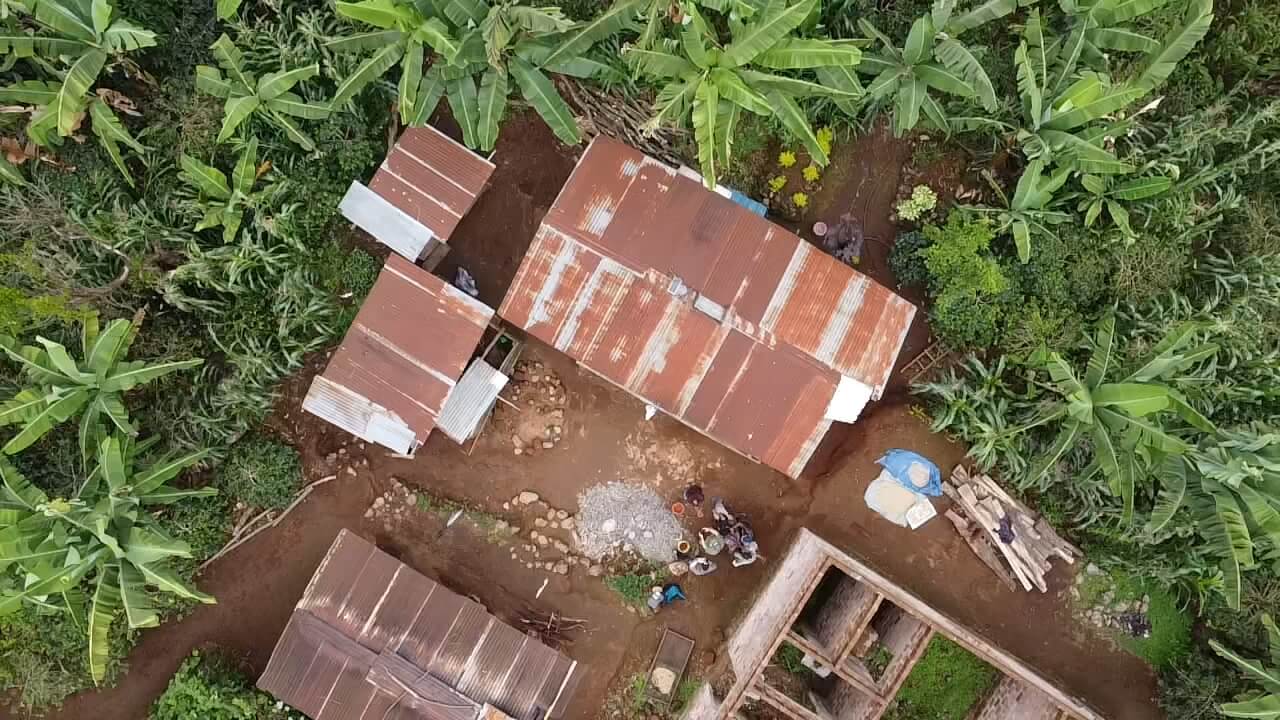
Thade’s house is further testament to the importance of the relationship EA has with the Orera Village. As I mentioned earlier, while this is my first trip to origin, this is not my first trip to East Africa, nor even its agricultural parts. When travelling in Africa, the majority of villages I have seen have consisted of almost entirely mud huts, or shacks of wood and corrugated sheet metal.

Like many in the Orera village, Thade’s house is made of brick and concrete, meaning that his family house will be safer and have greater longevity, lasting down his family’s generations. To us in the west this may seem like a strange thing to note, but it is truly a testament to what can be achieved when value is put back into farmers and smallholders, rather than the value of the crop being chipped away at by the various buyers and traders taking a cut of the profits in the markets. Sharing lunch at his house with his family is also a reminder that people and lasting, meaningful relationships are why we do what we do.

New Project With Omi School

It is our last stop of the day and we have made our way to the local school. We are standing outside a disused toilet block that is roped off and with good reason. The ground moves, bounces almost as though the floor is sprung. They were built on the caves in the mountain, the school’s principal explains but as the cave has eroded above and without the proper drainage, they are concerned that the floor could collapse at any moment. She taps her foot for emphasis and the floor shifts again. To the side of one of the toilets the floor has already given way and an unpleasant odour rises out of the pit.

These had been the boys toilets but since the threat of the toilets collapsing into the cave below, they have been using a new block of toilets that had originally been built for the girls. While the shell of that new block of toilets had been built by the government, the school had been left to find the funds to properly finish them. It seemed like this was something that we as EA should help with, especially since eighty percent of the children from the Orera village attended Omi School.

Climate Crisis - Kilimanjaro

Waking up we walk onto our veranda, looking up at the garden of our guest house at the Machare Farm. Our gaze is fixed far beyond the garden’s end.

It’s still cool, though in the short rains it won’t reach above the mid twenties. A veritable orchestra of different birdsong have already begun the dawn chorus that will continue throughout the day, such is the quantity and variety of life that teems in the trees that bathe the coffee farm in shade.

Beyond the rainforest, further up the slopes, who’s evaporating dew snakes lazily through the canopy. Our gaze is firmly fixed on the bank of cloud that is rolling away like a theatre curtain being drawn back, as though nature itself were taking joy in the theatrical, revealing of its own majesty. Kilimanjaro!

It stands dominating the landscape. The recent rain on the farm has translated as snowfall on the mountain. Its white cap is seemingly at odds with its tropical surroundings. It is hard not to be overwhelmed by its beauty. And yet, while we revel in this view and this moment it is also tinged with sadness.

The mountain’s summit slides out of view, once again obscured by a bank of cloud. The summit will reappear from time to time throughout the days, though its sudden disappearance of the snow swept slopes seems apt. The timing of the visit rides on the coattails of COP27. The conference being held on the African continent places a great deal of emphasis on the impact the climate crisis is already having on developing nations.

Much of the climate science published in the build up to and during the conference shared the same lens. Not a month earlier we had read a report that by 2050 a third of the world’s glaciers would be gone, including the Kilimanjaro glacier, the one we had just watched slip behind a bank of clouds.

The loss of the Kilimanjaro glacier is more than a matter of aesthetics. With the current rainfall the rivers that border the Machare Farm and through the Mweka villages, flow freely. The water bowsers for storing water and distributing it among homes are full. However when the rains stop, these rivers that feed all the life on these slopes, providing water to farms and farmers, rely on the glacial melt waters to flow year round. Without the glacier in the dry season there is a good chance the rivers will just vanish.

Conclusion

Leaving Tanzania it felt like we had packed a lot into just a few days. I had seen how the farm and the small holders worked, I had been astounded by the care that went into producing the coffee and had witnessed the impact of direct trade on the small hold farmers. We had spent time refreshing relationships and we had the possible beginning of a new project.

I’m returning to the roastery with a new sense of why the DNA of EA and what we do matter, both in the impact on the coffee and those who care for it at every part of its journey from farm to cup.

Elliott has been with EA since 2020. He is a big fan of hats, fixing stuff, skiing and alternative milk! He enjoys a pourover or cheeky flat white.
Elliott profile image
Elliott
Bean Machine!

Greenwashing

Stop greenwashing and tell the truth!

Introduction

With the word “ethical” in our company name you won’t be surprised to hear that we are often asked what ethics means to us; why we do what we do; how we do it; and what makes us different to others. Particularly being in the coffee world which in the past has had a notoriously bad reputation for the way it’s treated coffee growers and the environment. 

Our journey began in 2006 with a vision to sell high quality arabica in the UK at an affordable price whilst offering fantastic customer service. We also wanted to pay farmers what their coffee was worth and throughout the entire process be environmentally friendly.  By our own admission, we set the bar high!

We made it a priority to visit the coffee farms to not only see how the coffee was grown and processed, but to meet the farmers, giving us an understanding of what their lives were really like. When we got on the ground with small farmers, particularly in East Africa, we realised that if we worked through organisations like the Fairtrade Foundation then we wouldn’t be able to meet our own high standards. Although Fairtrade can be good we knew we could do more by working with the poorest farmers directly. We quickly realised that if we were going to work with these communities and do right by them, then we would need to work directly with them. We were determined to do the right thing, not just be seen to do the right thing. 

Fast forward to 2021 and it’s a very different market to 15 years ago. More consumers seem to care about ethics and more companies are taking up the mantle to support and work alongside coffee growers rather than exploit them. As a business we need to make a living for the EA team in the UK but also ensure the farmers we work with around the world are treated fairly and paid a good price for the coffee they produce. As we have always done, we continue to strive to be a more sustainable business and take the threat of environmental disasters and ecology seriously. We vowed to never rest on our laurels and to continuously make sure we are doing everything we can. 

And yet, there’s a real difference between those companies like ourselves that are genuinely in it to do the right thing and those who are simply jumping on the bandwagon for their own gain. They see the credentials of ethics and good behaviour simply as a marketing tool. It is what is known in the food industry as greenwashing[1].

It gets frustrating when you’re in this industry, or in any industry, trying to genuinely do the right thing, and all around you others are misappropriating language.

Greenwashing

There is an article I read recently by Greg Meenahan referring to this phrase, greenwashing, first coined by Jay Westervelt in 1986, which really resonated with me. So if whitewashing means to cover up unsavory or incriminating information to make a business look clean then greenwashing is when a company makes claims about environmental (or social) ethics but is not actually living up to those claims fully, maybe just doing the bare minimum, or in some cases outright lying. These situations are driven by a corporate culture of dishonesty and amoral behaviour for the purpose of profit rather than ethical behaviour.

You might be guilty of ‘green-washing’ if:

❒ You imply that a coffee is green based on an unreasonably narrow set of attributes, without paying attention to other important environmental issues.

❒ You make claims that cannot be substantiated by supporting information or reliable third-party verification.

❒ Your claims are so broad or poorly defined that their real meaning is likely to be misunderstood by the consumer.

❒ Your claims may be truthful, but are unimportant or unhelpful for consumers concerned about the economic and environmental well-being of producers.

❒ You make abundant use of jargon or technical information that the average person cannot understand or verify.

❒ You are making claims that are simply false.

‘Selling Sustainability’ Standart Magazine no. 21 – Greg Meenahan

This mindset can be true of all sized companies but it can be particularly noticeable from large corporations. It is easy for these large corporations to make these big claims, knowing that in some cases it takes a lot of time and resources to prove them wrong. 

A large multinational can say that they have donated a sum of money to a particular project which on paper sounds fantastic because it could be millions of pounds. Yet, when you look into how much profit they make, that donation is just a drop in the ocean. They may well spend more on promoting the ‘good’ they are doing to generate more profits for themselves than the amount they gave away. [2] [3]

In absolute terms, the amount given by large multinational companies is often more money than we could ever give away, so it is doing good for sure, but proportionally they could do so much more. At EA, we want to behave better in all our business relationships, and act generously from our heart to be more significant, and more proportional in the impact that we make. Our behaviour and generosity needs to come from a value and belief system, rather than trying to grab a marketing advantage.

In the coffee industry greenwashing is happening in both small and large companies. It gets frustrating when you are in this industry, or in any industry trying to genuinely do the right thing, and all around you people are misappropriating language. In this article I want to talk about some of the morally grey statements that are used in marketing within the coffee industry. The type of things that sound fantastic on paper but in reality, make little to no difference whatsoever to the coffee farmers or the environment. 

For obvious reasons I will not be naming names. This is more of a ‘for your information’ type of article to inform you of what is happening and what you decide to do with it is up to you.

Zero effort Veganism

With the driving popularity of veganism, there are a lot of companies promoting their coffee as ‘plant-based’.  It is a seed, all coffee is plant-based!  

That’s not to say we haven’t been completely innocent of playing up to this marketing ourselves during ‘veganuary’, granted it was a tongue in cheek effort. 

Donating to charity but selling the product for a much higher price

This happens a lot in many industries, but I saw one coffee company who teamed up with a charity and said, ‘for every bag that we sell, we’re going to donate a pound to this charity.’ At face value, that sounds fantastic. The coffee bag was the same weight and contained the same grade of coffee, BUT the price was increased to cover the donation and a bit more!  So they were justifying selling coffee at a much higher price because it was for ‘a good cause’, whereas in reality they were not donating anything themselves, and in fact earning more from the promotion.

Girl Power?

I have seen a significant increase in adverts promoting equal opportunities and empowering women in the coffee industry from growers and pickers, through to roasters and baristas. And to some extent, so we should, but it infers that certain companies are supporting women in the coffee chain more than others, or that women are kept in the minority.  The truth of the matter is that the majority of coffee across the globe is picked by women during harvest time[4], that is one of the jobs that they have done for a very long time and will continue to do.  So, ‘hand-picked by women’ is not a unique credential, or a good thing one company is supporting, it is nothing more than a long-standing fact exploited for marketing purposes. 

If companies actually want to make a positive impact for women then giving women more influence within their communities would be a really positive step forward.

Weightier issues

What about the instant coffee company that stopped selling in glass jars and switched to ‘refill pouches’, proudly claiming a 98% reduction in packaging? A small asterisk led you to read the (very) small print that simply said “98% less weight.”  The irony being that at least glass is recyclable and the pouches were not!

CSR or just tick box ethics?

CSR or Corporate Social Responsibility, is a set of policies and commitments laid out by a company which states how they are going to be a beneficial influence on the world. That can mean volunteering time and money to charities, dealing with environmental issues or defining their ethics within their particular industry. 

It is really frustrating to see businesses who just use CSR as a marketing tool rather than having a genuine desire to do the right thing. Those organisations who outsource their CSR so they can go down their CSR audit, tick some boxes and then the marketing team use it as a sales tool to say how great they are. It is a very cynical way of thinking and we are not interested in that at all.

Direct Trade

We use the term direct trade to explain that we literally trade directly with farmers.  You would think something like trading direct or direct trade as a phrase doesn’t need any explanation. They are two really simple English words that we all use and yet, the phrase gets misused or even abused. 

So sadly, we feel the need to clarify our definition. We know everything throughout the process, including the environmental and social conditions for our farmers. We literally buy direct from the farmer or smallholder community, negotiating volume, quality and price. We offer full transparency. That for us is direct trade. 

In our opinion the phrase ‘direct trade’ should only be used in this scenario. It should not mean that you buy from someone who buys from someone who trades directly – there is always someone in a chain who has to trade directly with the producer. It is not that you know some of the details of the trade; not that you have a photo of the farm, or even that you visited once. Direct trade seems like it should be clear and obvious in what it means, but it gets manipulated to mislead consumers all too often.

Now the caveat in that, is that trading directly does not mean you are necessarily doing the right thing. In theory, you can trade directly with farmers, even pay them slightly more and make a larger profit by cutting out the middlemen. It is also no guarantee of working conditions or environmental care, this only comes through transparency and openness of the company who are trading.

So, when EA says ‘ethical’ – what do we mean?

‘Direct Trade’ we think is easy enough to define but ‘ethical’ is not.  It is broader, more nebulous and of course subjective – where I set my ethical bar may be different to yours, there is no absolute ethical value. The big question in ethical business is who defines it and where does the company choose to set the bar? For us, it means being transparent, showing customers, our farmers and those we are accountable to exactly what we are doing. Our founding principles were to set the bar particularly high, because that’s our ethical value. Others may set the bar lower and genuinely for them that is their ethical value and there may be nothing wrong with that.

My biggest frustration is organisations claiming credit for what other coffee companies are doing just for marketing purposes rather than just being honest. Honesty is all that we ask for.

With most of these concerns and questions for us it comes down to the heart value.  Are we operating this way because it’s who we are, and how we want to behave to make a better world and to treat people well, or is it simply a business gimmick?  For us it’s in our DNA. 

To be honest our business would be much easier if we did it differently, but by trading directly wherever we can; investing in coffee producing communities; being generous with our profits; striving for excellence in our products and customer service – in all this we are trying to live out heart values that drive us personally and corporately for our behaviour as human beings and as a business.

To be honest our business would be much easier if we did it differently, but by trading directly wherever we can; investing in coffee producing communities; being generous with our profits; striving for excellence in our products and customer service – in all this we are trying to live out heart values that drive us personally and corporately for our behaviour as human beings and as a business.

What does transparency mean to EA?

Put simply, openness and honesty. We encourage questions and accountability. We try to be clear who we are, what we do, and what we don’t do that we want to improve. Happerley Transparent is a company that takes the time to research food companies to discover which ones are being fully transparent and honest about the claims they make. We were one of the founding members because we have nothing to hide. They have checked all our supply chains and certified us to their highest ‘Gold Standard’, which confirms that we practice what we preach. We are proud to be part of a food community who have similar principles to ours.

A few years ago, journalist Connor Woodman investigated us as part of his research whilst writing  the book Unfair Trade “How big business exploits the world’s poor and why it doesn’t have to”.  Initially checking out whether we truly did what we said or not, he ended up using us as an example of positive alternatives to ‘unfair traders’.  He visited us in Gloucester, then travelled to Tanzania, to meet the farmers who grow coffee on the highest slopes of Kilimanjaro.  Alongside other great companies with great ethics, he included EA in two chapters of the book. 

We’ve also had numerous undergraduate and post-graduate students write about us as part of their academic research and I have also been asked to speak on this to various groups, universities and podcasts. 

For us at EA though, the most important people who testify to our claims through the last fifteen years are the farmers we work with, and our loyal customers. Videos, interviews, and online reviews testify to our values and authenticity.

So my wish is that ethics becomes the DNA of UK coffee companies, rather than just being something that is outsourced to tick a box, or manipulated for marketing gain. I hope that transparency becomes a part of corporate social responsibility rather than a marketing tool.

And I guess the challenge for us as individuals is to decide how our ethics affect how we purchase and consume and who we choose to buy from.  

Ethical Addictions Coffee Roasters
Privacy Overview

This website uses cookies so that we can provide you with the best user experience possible. Cookie information is stored in your browser and performs functions such as recognising you when you return to our website and helping our team to understand which sections of the website you find most interesting and useful.